Showing posts with label Reviews. Show all posts

Wednesday, April 1, 2015

Top Dog Reviews: But Wait, There's More!

I've just realised that I am in the interesting position of having been a huge fan of the original print and play version of But Wait, There's More! and also having a brand new, shiny copy of the Kickstartered version. Methinks a review and comparison is in order!

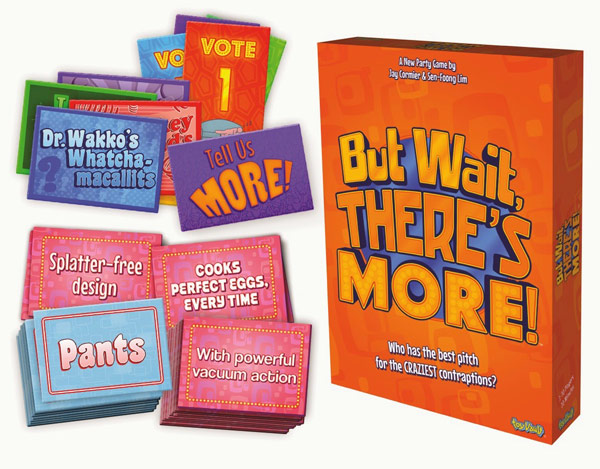
But Wait, There's More is a game about advertising. Specifically, it's about those terrible late night shopping ads. The idea is pretty simple, a product card is selected for the round - it might be a knife, it might be a frying pan, it might be a wagon. Then all the players select a feature from their hand of cards - possibly 'remote controlled', maybe 'with wheels' and has thirty seconds to improvise an ad for the resulting product. At some point, they MUST say 'But Wait, There's More!' and draw a random feature card, whicb must be added to the product. So you could end up advertising a remote controlled wagon... WITH WHEELS! At the end of each round, players vote on which they thought was the best ad.

So, what was changed for the Kickstarter version?
Well, for a start, all the product and feature cards are new. This cuts both ways - I play with a teen aged group, and some of the old features, such as 'closed circuit TV' and 'closed captioning' kept giving them trouble. A few other features were a bit old school, thanks to the march of technology. 'With QWERTY Keyboard' is probably not such a selling feature anymore. On the whole, the feature cards now read like sales pitches, instead of just naming a product. This helps integreate them into your pitch faster, and they are all now things which you would expect to see on late night shopping ads. The thing is, far fewer of them make sense with the products. Since the whole point of the game is advertising ridiculous combinations this isn't too bad.

The voting mechanic has also changed. In the past, each player had one vote, which they gave to the best ad in that round. The winner was the first to win three rounds. Now, each player is dealt a hand of vote cards each round, and gives their favourite speach the '3 votes' card, their next favourite the '2 votes' card, and so forth. The game ends after three rounds, and votes are totalled up. I like this system more - it means you can reward more players, and it also means there is more tension since no one knows how many votes they have until the end of the game when the cards are turned over and totalled.

Another very handy addition to the game is the egg timer. It's a little thing, but since this is a boxed game, not a Print and Play anymore, they can include an egg timer which makes things easier. Timing 30 seconds on a phone was always a bit of a pain, the egg timer is much more convenient and easier to see for all players.

With the changes to the core mechanics of the game out of the way, what else has been added? Well, the kickstarter includes one new mechanic, and an expansion. The new mechanic is the 'Tell us more' card. This card goes to the player who's birthday is closest, and can be played after any other player's ad. Basically, the victim of the card has to turn over a third feature card and keep going. They can then keep the 'Tell us more' card and use it when they want. The expansion, called 'That's the best part' adds a set of yellow cards. Each player gets two of these at the start of the game, and they are not replaced during play. They are also played after an ad, and all ask a question such as 'what happens if I eat it?'. Then you have to say 'That's the best part...' and turn the problem into a selling point. There is no limit to the number of these cards you can have played on you - I have had a round go for almost five minutes having been hit with 'Tell us more' and six or seven 'That's the best part' cards. It was an amazing product, but it gave me a sore throat...

The PNP version of But Wait, There's More was a popular fixture of Gippsland Gamers. The Kickstartered version looks like taking on the very same place in our hearts. The game is always highly entertaining, it never outstays it's welcome, and it's very easy to learn. This is currently my favourite party game, but that might be somewthing to do with being a Media/English teacher. The new version tidies things up, has excellent presentation, and comes with the excellent expansions AND the invaluable egg timer - what more could a man want?

THE VERDIT:
But Wait, There's More (Toy Vault edition) scores:

Clarity of rules:
Excellent. The rules are short and sweet, so there is nothing to get confused by. The rules as written suggest that you replace your whole hand of features each round, but we've house ruled it to only replacing the ones you don't want, like the PNP edition. Sometimes you just KNOW the feature will work, but not on the product in play...

Learning curve:

There's really not much to learn, and it can be easily and quickly explained in a minute or two. The real trick lies in learning how to speak for thirty seconds - once you get that timing right there's no stopping you.

Fun:

Like all party games, this would depend on your group. People who do not like to talk will hate this game, but with the right group it's amazingly entertaining. Our group does contain some fairly shy people who dislike public speaking, but when we play, they tend to get caught up in the fun and really get into it. Obviously, this game requires a certain level of speaking skill, it's not something you should play with small children for instance.

Replay Value:

Sure, there are a limited number of combinations in the product and feature cards, but the number is pretty damn huge. We've been playing this game every other week or so for over a year, and I still get loud requests for it to hit the table. Sometimes we play two or three times in a night. Any game which involves crazy combinations of unlikely things tends to be pretty replayable, and this one is no exception.

Presentation:

The box is solid, the cards are colourful, the text is clear. The presentation is not going to set the world on fire, but it does it's job. The old PNP used a bunch of different fonts on the feature cards, the new version sticks to just one, which helps clarity. The only thing which annoys me is that the cards are all the mini sort, and I find them hard to shuffle... It's a bit bland, but you're not really looking at the components, you're listening to the other players, so it doesn't hurt the game.

Sunday, September 22, 2013

Top Dog Reviews: Star Wars Edge of the Empire Beginner Box.

When I saw the Edge of the Empire beginner box, I got all excited. Four pre-generated characters, an adventure which teaches the rules, some nice maps, and lots of fancy dice. What's not to get excited about? So I picked up a copy a couple of weeks ago with some birthday money, and last night we gave it a spin.
Having read the adventure, I ran things with Matt and my brother Nik as players. Matt's done some role playing, and has plenty of game experience. Nik has not played anything since 2nd ed 40K, but held the rank of general in the old Tie Fighter computer game. So a good test of the game's teaching abilities and learning curve.
The adventure is really well thought out - each encounter takes up a few pages, and each of them teaches a new part of the rules. They each build on the one before so that everyone learns how things work as they go. Even the GM doesn't need to read the rules before hand, because it's all explained on the page. Having read things before helps, but you could grab the box, grab some mates, and jump right in.
The adventure itself is fairly short since you'll take longer than normal to play as you are all learning as you go. It took us two or so hours. That said, it's got plenty of action and there's even an interlude where you can level up and gain some experience. By the end of the session, we all knew what we were doing, and felt pretty confident with tackling more of the game. Except that Nik's wookie had been knocked out defeating the final bad guy...

Fantasy Flight's Star Wars games use special, fancy Star Wars dice instead of the more common numerical kind. They are covered in baffling symbols, but you quickly get used to the system. There are successes, failures, threats, advantages, triumphs and despairs. All of these interact to give a final result, and both players and GM can use the more exotic things (advantage, threat, triumph and despair) to do more interesting things, trigger special abilities, and generally make the game more cinematic. Half way through the adventure, the Fate pool is introduced. The players can spend light side fate tokens to improve their chances, and the GM can do the same with the dark side. Except whenever a point is spent, it gets flipped over and becomes the opposite! I really like this mechanic since it makes you think hard about using fate or not.

So, how does the Beginner Box stack up?
Well, it's about the most fun I've ever had learning a game system, it's probably the first time I've learnt a system by playing it without an experienced player, and it really does a great job of teaching the game. The down side is that you have to use the pre generated characters, and there's nothing in there about making your own. You can download two more free characters and an extra adventure from Fantasy Flight, and you can keep playing with the pre generated characters and make your own adventures, but you will be a little limited unless you invest in the full game.

Matt has a copy of the Beta release of the full book, which I have flicked through - it has some more mechanics and levels of detail, but apart from that the rules look basically the same, so the beginner box will get you started, but won't last you that long. Of course, it's pretty cheap, and you can use it to teach other players and get them to join in - I have some other friends who are interested in having a go, so I'll be running this again.

Over all, the Beginner Box is an excellent jumping off point for the hobby. It gets you up to speed quickly, and very enjoyably, and gives you the tools for your first steps. It doesn't give you the complete experience, but you could actually play a fairly long campaign using just the contents of the box and the free bonus adventures and characters online.

THE VERDICT:
Star Wars Edge of the Empire Beginner Box scores:

Clarity of Rules:
Excellent. The only thing I was a little confused by was how to generate your own dice pools - I was very tired when I first read it. On a second read when wide awake it made perfect sense.


Learning Curve:
The whole game is designed around the learning curve, and it's probably the best 'learn as you play' RPG set I've encountered. A great way to learn, and you're supported and assisted all the way.


Fun:
The starter adventure is quite enjoyable, and we got some good laughs and dramatic action. Especially the final epic fist fight between Trax and Nik's Wookie character in the corridors of the Krayt Fang.


Replay Value:
You can replay the same adventure as the GM, but once you've played it as a PC you know the secrets and know what to do, so it's not really worth playing again. That being said, you can then use the rules and stats included to create your own adventures.


Presentation:
Fantasy Flight have really got their presentation nailed. The art is great, especially rhe painting which has been slighlty photo-shopped to show Han and Chewie playing the game (Han's not doing well, Chewie obviously just rolled a critical hit...)


Sunday, February 17, 2013

First play: Fanticide

I first became aware of Fanticide when Nic Robson at Eureka mentioned it to me. Then Matt got excited about it, accidentally bought two copies, and sold one to me. I would've bought it anyway, but this just sped things up.
I like the rules - they are clear and simple, and easy to apply. I also like the rules for creating your own units. It allows me to finally use all those silly things Nic at Eureka has sold me over the years. I like the feel of the world of Nowhere, although the fluff is not the best written fluff I've seen in a game. I like the challenge of developing new terrain to fit the game.
So do I like to play the game?

On Saturday, Matt and I met up at Hampton Games Club to put Fanticide through it's paces. We'd both read the rules about two weeks ago when we got them, so we'd forgotten a few things... Matt's ordered the basis of his clock-work puppet army, but is still waiting for it (I'll try to persuade him to post the army list to the blog so you can see what he's thinking). I'd bought the core of my Insatiable army from Eureka on friday night, and I ordered the rest of it from Reaper this morning. So neither of us had a full army. Fortunately, I had some Eureka warrior mice which I painted up long ago, and had written Fanticide rules for, so Matt used them.

Warrior mice ready for action.

I took two squads of three Devourers each, led by a Lord of Rapacity. Apart from the Vice of Hunger, the special rules did not come in to play. After some more play-testing, I'll put the army list up.


Name:
Give
Take
Soul
Agility
Spirit
Sanity
Devourer
3
3
2
4
6
4
Equipment:
Equipment Options:
None.
Two handed Weapons (+9)
Special Abilities:
Vice of Hunger


Name:
Give
Take
Soul
Agility
Spirit
Sanity
Lord of Rapacity
4
4
5
4
5
4
Equipment:
Equipment Options:
None.
May choose up to three artefacts, one of which may be a relic.
Special Abilities:
Vice of Hunger, Soul Powered Attacks, Soul Powered Spells, Virtue of command.
3 Spells.
Retainers:
The Legend can be accompanied y a squad of 2-6 feeder drones at 10 points each.


Matt took three squads of three Warrior Mice each - one slashers, one stickers, and one shootists, led by a Warrior Mouse legend mounted on a giant rat.


Name:
Give
Take
Soul
Agility
Spirit
Sanity
Warrior Mouse
2
2
1
6
6
6
Equipment:
Equipment Options:
None.
Blades: +4 points
Bows: +5 points
Spears: +2 points.
Special Abilities:
none


Name:
Give
Take
Soul
Agility
Spirit
Sanity
Mounted Legend
4
5
4
9
5
4
Equipment:
Equipment Options:
Blade, Shield
Up to 3 artifacts, one may be a relic.
Special Abilities:
none


It was a small game, based on what we had available, and the points did not quite match up (176 vs 166 from memory). We decided to use a two foot by four foot table, with a hill in the middle, and an Obo stone near each deployment zone.
Matt rolled the Sin of Envy, and I rolled Greed, so we ended up both riddled with greed. Since the game size was small, we decided to have two objectives each, with one more randomised from the center of the table. This one ended up close to Matt's edge. We used some giant mushrooms for the objectives.

Insatiable deployment.

Mouse deployment.
As to the game, well, it was quick, and it was bloody. Turn six ended with Matt having just two mice, and me having only my legend, the Lord of Rapacity. We'd both captured and removed a mushroom. My legend had more soul than the mice, so I won. Just.
The mouse legend buggers off with his mushroom prize.
The events played a major roll in the game. I got lucky with my legend effected by the Fanticide! event,  and the Time Slip event was also favourable to my forces. Of course, I also got hit by the Droppings Storm, so it evened out.
Devourers make for the Obo stone and glory!
Since it's two weeks since we read the rules, we did a few things the wrong way. We got confused about Spirit and Sanity checks, having played to much Warhammer and Warmachine, and tried to roll under our stats, not over them, and we forgot stuns in combat. But it all seemed to balance out in the end. We're certainly going to keep playing this game, and I'm looking forward to getting my armies ready and a whole table worth of terrain. I also plan to use this game at my school wargames club, as the squad-by-squad activation system means I can easily put one kid in charge of each squad, under the over-all command of a legend player. It's hard finding a skirmish game which can support upwards of eight players, and that's how many players I regularly get...

Once I have more experience of the game, I'll put up a more in-depth review.

Frivolous pretty picture showing the Devourers beating up the mouse legend while the Baba Yaga hut watches.

More frivolity which never happened in the game.

Wednesday, October 3, 2012

Top Dog Reviews: Eat Poop You Cat

I've decided to do some game reviews on this blog, but I want my first to be something a bit... different.
I could just rush out and buy the shiniest, newest board game everyone is raving about and join in, but then, everyone else is doing that. So my first review is a game I stumbled on over on Board Game Geek, which doesn't even come in a box.
It's called 'Eat Poop You Cat' but when I use it in my class room, it's called 'Paper Telephone'.
And it's a real game.
Despite the name.

What's in the box?

Nothing. It doesn't come in a box. Actually there's a form which you can buy, but who wants to spend money?

How do you play?

Okay, you get a group of friends and you each take a piece of paper and a pencil. Everyone writes a sentence at the top of their page, and passes the sheet to the player on their right. That player then tries to draw a picture of what is happening in the sentence. They fold the paper so only the picture is visible, and pass it along. The next player writes down what they think the picture shows, and folds the paper so only their sentence is visible. This keeps going until you run out of paper, and unfold it to see what happened. Hilarity ensues.
I play this regularly at family gatherings, and it's never fallen short of abject laughter. Particularly famous examples include 'The Lion suffers from premature ejaculation by a water hole' and 'The sheep perform a dance expressing their joy at their regularity' (These started as 'Down by the river, a Lion attacks a Zebra' and 'The Dark Dog Does a Diabolical Doo-Doo in the Doorway' respectively)

How hard is it?

It's a very easy game. I play with my family, and they have no problems. I also use it for my yr.7 English class on occasion.

What's the replay value like?

Very high. It's a simple game, it's a hilarious game, and no two sessions are ever the same. We've played it for over a year, and my sister-in-law still insists we play it at family gatherings ahead of all the shiny, fancy board games we have accumulated as a family.

The Verdict:

Eat Poop You Cat scores:

Clarity of rules:

Depends on how well I explain them... they're not written down anywhere since it's just a game I found on the internet. It's not hard to explain, and not hard to grasp.

Learning curve:

Once you figure out which way to fold things, and which way to pass, there's nothing much to learn.

Fun:

Ludicrously high fun levels for such a simple idea.

Replay value:

It's very VERY replayable. 

Presentation:

Er... it doesn't have any. Like I said, it's an idea I found on Board Game Geek.